
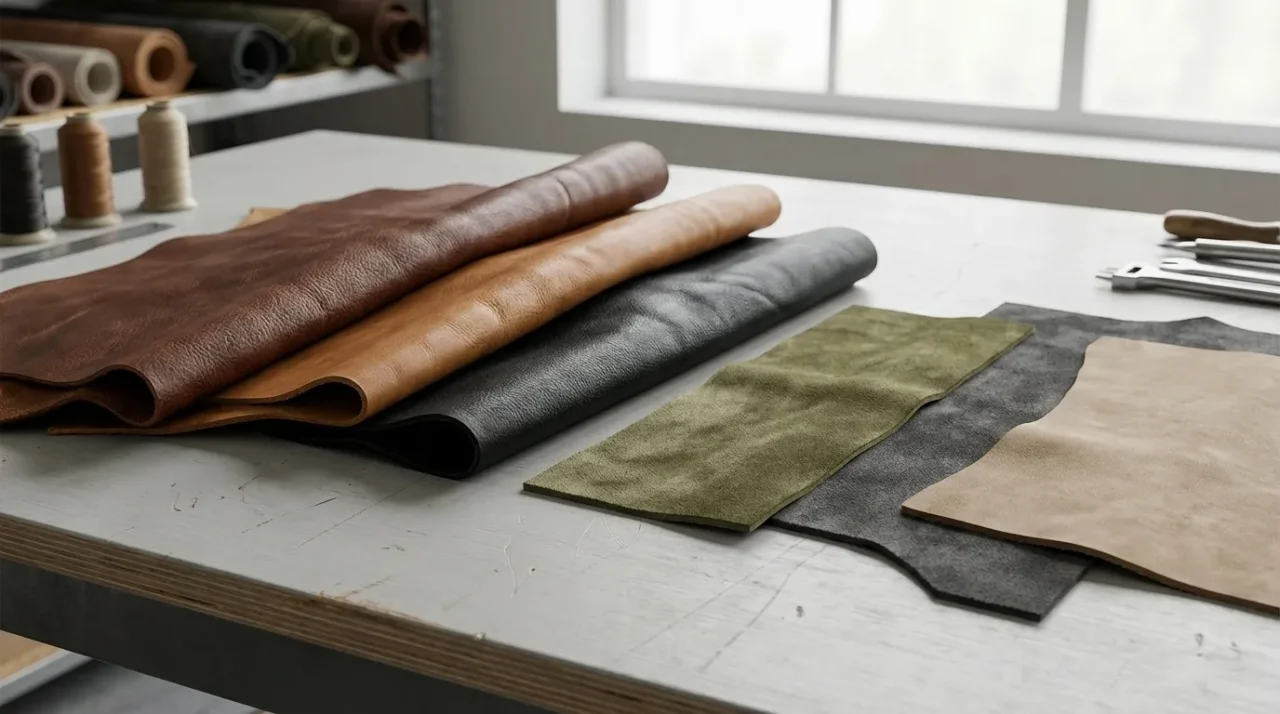
Leather selection plays a decisive role in footwear manufacturing quality, durability, comfort, and sustainability.
Different leather types, finishes, and sourcing methods directly affect performance, brand positioning, and production outcomes.
For private label footwear, choosing the right leather is not just a material choice, but a strategic manufacturing decision.
Introduction – Why leather matters beyond aesthetics
In private label footwear manufacturing, leather is often perceived as a visual or tactile element. However, for brands operating in the premium and mid-premium segments, leather selection is a strategic decision that influences product performance, durability, sustainability, and long-term brand value.
The type of leather used in shoe production affects how a shoe behaves over time, how it adapts to the foot, how it performs in different environments, and how it aligns with market expectations. For B2B buyers, agents, and footwear brands, understanding leather characteristics and footwear material selection is essential to making informed production decisions.
In private label footwear manufacturing, leather selection also impacts development timelines, prototyping accuracy, cost control, and production consistency. This is why experienced manufacturers treat material choice as an integral part of the technical development process rather than a final styling decision.
Table of contents
- Why leather selection is a strategic manufacturing decision
- Main types of leather used in footwear production
- How leather impacts durability, comfort, and performance
- How leather finishing processes influence footwear quality
- How sustainability and traceability shape leather sourcing
- Why Portuguese footwear manufacturing stands out in leather selection
- How LG Shoes supports brands in leather selection
- FAQs
- Editorial note
1. Leather selection as a strategic manufacturing decision
Choosing leather is not simply about selecting a color or texture. It involves evaluating performance requirements, target markets, sustainability standards, and expected product lifespan within footwear manufacturing.
From a manufacturing perspective, leather affects:
- Structural stability of the upper
- Stitching behavior and seam resistance
- Comfort and breathability
- Resistance to wear, moisture, and deformation
- Compatibility with specific construction methods
For brands selling in markets such as Germany and the United States, leather quality is closely associated with trust, durability, and ethical production standards. Poor leather choices often result in premature wear, inconsistent sizing, or customer dissatisfaction, even when the shoe design itself is well executed.
As a result, leather selection must be aligned with the intended use of the footwear, whether casual, premium, outdoor, or lifestyle oriented.
2. Main types of leather used in footwear production
Understanding the types of leather used in footwear allows brands to better define product positioning and performance expectations.
-
Full-grain leather
Full-grain leather is considered the highest quality option in premium footwear production. It retains the natural grain of the hide and offers excellent durability, breathability, and aging characteristics. Over time, it develops a natural patina, which is often associated with premium footwear.
This type of leather is ideal for brands focusing on long-lasting quality and authentic material expression.
-
Top-grain leather
Top-grain leather is slightly corrected to remove surface imperfections. While it maintains good durability and comfort, it offers a more uniform appearance. This makes it suitable for brands seeking balance between aesthetics, performance, and cost efficiency.
-
Suede and nubuck
Suede and nubuck are created by sanding the inner or outer layers of the hide. These leathers provide a softer, more casual appearance but require careful finishing and protection. They are commonly used in lifestyle and fashion-driven collections.
-
Corrected and coated leather
Corrected leathers undergo surface treatments to achieve uniformity. While they can be visually consistent, their performance and breathability are generally lower than natural grain leathers. Their use should be carefully evaluated depending on price positioning and product expectations.
3. How leather impacts durability, comfort, and performance
Leather is one of the most influential components in determining leather durability and performance over time. Beyond appearance, its physical properties directly affect durability, flexibility, breathability, and overall wearer comfort.
High-quality leather adapts naturally to foot movement, reducing stress on seams and construction points. This adaptability contributes to long-term comfort and minimizes deformation during wear. Poor leather quality, by contrast, often leads to cracking, stiffness, or uneven aging, even when the construction method is technically sound.
From a performance perspective, leather thickness, fiber density, and tanning method influence resistance to abrasion, moisture, and temperature variation. These factors are particularly relevant for footwear intended for repeated use, extended wear, or demanding environments.
For brands, understanding how leather behaves throughout the product lifecycle is essential to aligning material selection with consumer expectations.
4. How leather finishing processes influence footwear quality

Leather finishing processes affect not only aesthetics but also breathability, surface resistance, and long-term durability.
Natural or lightly finished leathers preserve the original fiber structure, allowing better air circulation and aging behavior. Heavily coated or corrected finishes may offer visual uniformity, but they often reduce breathability and limit the leather’s ability to adapt naturally to the foot.
Different finishes also impact how leather responds to environmental exposure, such as humidity, friction, and temperature changes. For this reason, finishing decisions must be aligned with the intended use of the shoe, whether for casual wear, premium collections, or performance-oriented products.
In professional footwear manufacturing, finishing is evaluated as part of the technical development process, not as a purely aesthetic choice.
5. Sustainability, traceability, and ethical sourcing
Sustainability has become a defining factor in leather selection, particularly for brands operating in European and North American markets, where sustainable leather sourcing is increasingly expected. Buyers increasingly expect transparency regarding material origin, tanning processes, and environmental impact.
Ethical leather sourcing involves working with certified suppliers, responsible tanning practices, and traceable supply chains. These elements reduce environmental footprint while ensuring compliance with international standards and structured environmental management systems, such as ISO 14001 environmental management certification.
Traceability also supports consistency in production. When leather origin and processing methods are clearly defined, manufacturers can maintain stable quality across collections and production runs.
For private label footwear, sustainability is no longer an optional value-add. It is a core requirement that influences brand credibility and long-term market positioning.
6. Why Portuguese footwear manufacturing stands out
Portugal has built a strong reputation in Portuguese footwear manufacturing due to its technical expertise, material knowledge, and close collaboration with European leather suppliers. This ecosystem allows manufacturers to maintain high standards of quality, flexibility, and ethical production, supported by a strong European footwear industry framework.
Portuguese manufacturers are known for their ability to support brands during material selection, offering technical guidance rather than limiting choices to predefined options. This collaborative approach ensures that leather selection aligns with construction methods, product positioning, and market expectations.
In addition, Portugal’s footwear industry benefits from shorter supply chains, skilled craftsmanship, and strong compliance with European sustainability regulations. These factors contribute to consistent quality and reliable production outcomes.
7. How LG Shoes supports brands in leather selection
Leather selection is most effective when brands are supported by experienced manufacturing partners who understand both material behavior and production realities.
LG Shoes works closely with brands, agents, and buying offices to support footwear material selection based on performance requirements, construction methods, sustainability goals, and target markets. Rather than offering generic material choices, the development process includes technical guidance to ensure that selected leathers are compatible with the intended footwear design and usage.
This collaborative approach helps brands reduce development risks, optimize prototyping, and maintain consistent quality across production runs. By integrating leather selection into the early stages of product development, LG Shoes supports informed decision-making and long-term product reliability.
For private label footwear, this level of material expertise is essential to achieving both technical excellence and brand consistency.
8. FAQs
Does higher leather quality always mean higher cost?
Not necessarily. While premium leather may have a higher unit cost, it often reduces long-term risks such as returns, durability issues, and inconsistent performance.
Is leather selection relevant for all footwear categories?
Yes. Even in casual or lifestyle footwear, leather choice affects comfort, aging, and perceived quality.
Can sustainable leather meet premium performance standards?
Yes. Many certified and responsibly sourced leathers meet or exceed performance requirements when correctly selected and processed.
How early should leather be selected in product development?
Leather selection should be considered during early development stages to ensure compatibility with design, construction, and performance goals.
9. Editorial note
Leather selection is one of the most critical decisions in footwear manufacturing. When approached strategically, it supports product quality, sustainability, and brand positioning. For B2B buyers and footwear brands, working with manufacturers who understand materials at a technical level is essential to building reliable and competitive collections.


 English

