
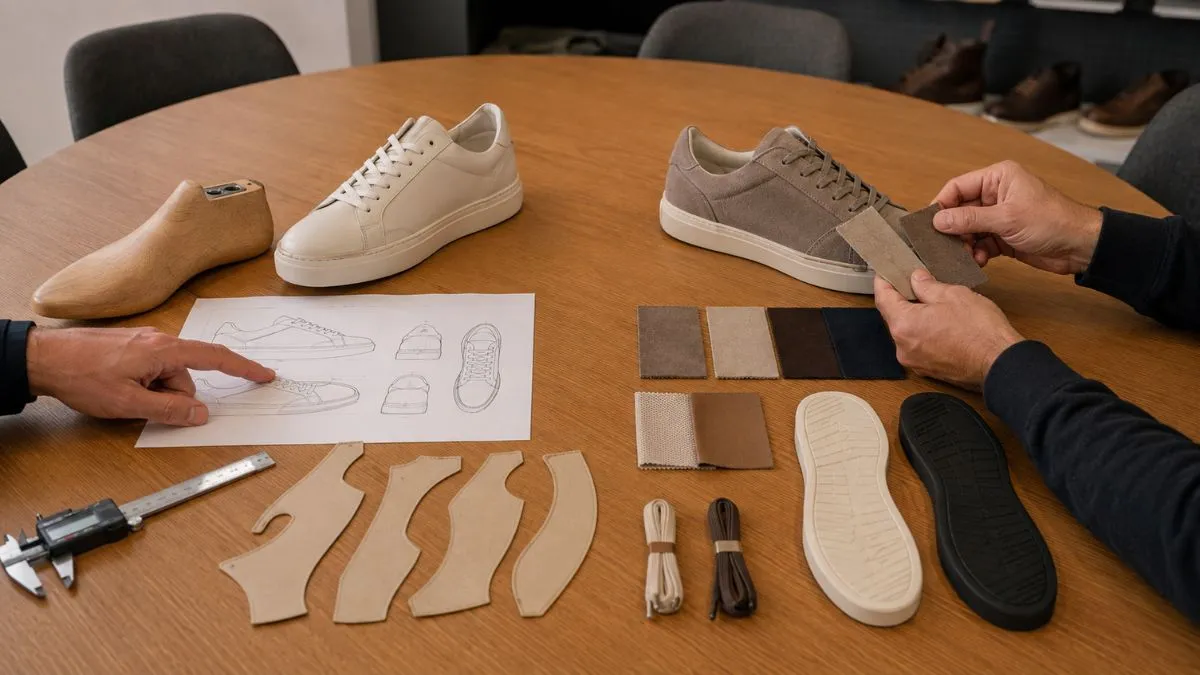
Choosing between OEM and private label footwear is not simply a matter of selecting one manufacturing label over another. The decision affects how the product is developed, who defines the technical specifications, how much customization is possible, and which responsibilities remain with the brand.
The terminology can also be confusing. In footwear sourcing, manufacturers, agents, and brands do not always use OEM and private label in exactly the same way. Some use private label as a broad term for any product manufactured for another brand, while others reserve it for collections based on existing models or development platforms.
For this reason, the real OEM vs private label footwear decision should focus on the scope of the project rather than the terminology alone. Brands need to understand who provides the design, who manages technical development, which components already exist, what can be customized, and who owns the resulting assets.
At LG Shoes, a Portuguese footwear manufacturer working exclusively with international B2B clients, these questions are clarified during the initial evaluation of each project. This guide explains the practical differences between OEM and private label footwear and helps brands identify which approach best supports their product strategy.
TL;DR
This OEM vs private label footwear guide compares the two approaches from the brand’s perspective, including development responsibilities, customization, ownership, costs, and project suitability.
Because OEM and private label footwear can overlap, brands should evaluate the actual project scope rather than rely only on terminology.
- OEM usually starts with a brand-owned design or detailed product specification.
- Private label may begin with an existing model, component base, or manufacturer-supported concept.
- OEM generally gives the brand greater product definition responsibility.
- Private label can reduce development complexity when suitable references already exist.
- Neither model automatically guarantees lower MOQs, costs, or faster lead times.
- Tooling, patterns, lasts, molds, and design ownership should be clarified in writing.
- The right model depends on the brand’s experience, resources, differentiation needs, and launch strategy.
Table of contents
- Why OEM and private label terminology varies
- What does OEM footwear manufacturing mean?
- What does private label footwear production mean?
- OEM vs private label footwear comparison table
- Which model gives brands more product control?
- How do OEM and private label affect cost, MOQ, and lead times?
- How should intellectual property, tooling, and exclusivity be handled?
- Which footwear manufacturing model suits your brand?
- Questions to ask a footwear manufacturer before deciding
- People also ask
- Final thoughts
- Frequently asked questions
Why OEM and private label terminology varies
The first difficulty in comparing OEM and private label footwear is that the terms describe related but different aspects of a manufacturing relationship.
OEM commonly refers to original equipment manufacturing. In a typical OEM project, the manufacturer produces footwear according to a design, technical specification, or product direction supplied by the brand. The manufacturer may support engineering and development, but the original product definition generally comes from the client.
Private label footwear refers more broadly to footwear manufactured by one company and sold under another company’s brand. The starting point may be a fully original brand design, an adapted reference, an existing sole or last, or a model developed collaboratively with the manufacturer.
This means a product can be both OEM and private label. A manufacturer may produce a brand-owned design according to the brand’s specifications, while the finished product is marketed under that brand’s private label.
Some suppliers also use the term ODM, or original design manufacturing, when the manufacturer provides more of the initial design or product concept. However, the boundaries between OEM, ODM, and private label vary between suppliers.
Brands should therefore ask what each proposal includes instead of assuming that the terminology alone defines the relationship.
What does OEM footwear manufacturing mean?
In an OEM footwear manufacturing project, the brand usually approaches the manufacturer with a relatively defined product direction.
This may include:
- Original footwear sketches or digital designs.
- Technical drawings and product specifications.
- Reference samples or existing products.
- Defined materials, colors, components, and construction requirements.
- Brand-specific fit standards or an existing last.
- Proprietary outsole concepts or tooling.
- Detailed finishing and quality requirements.
The manufacturer’s role is to translate those inputs into a commercially manufacturable product. This can involve pattern engineering, material sourcing, component evaluation, sample development, fit adjustments, construction guidance, and production planning.
OEM does not mean that the manufacturer follows every instruction without technical review. A reliable footwear partner should identify feasibility problems, recommend suitable alternatives, and explain how design decisions affect quality, cost, and production.
The brand nevertheless retains greater responsibility for defining the product. Incomplete specifications, inconsistent drawings, or unclear approval criteria can create repeated sampling and longer development cycles.
OEM is generally most appropriate for brands that already have a clear design identity, internal product knowledge, or technical resources capable of preparing and approving detailed footwear specifications.
Brands preparing an original product concept can review the LG Shoes guide to footwear design and development to understand how an idea progresses toward a production-ready prototype.
What does private label footwear production mean?
In a private label footwear project, the product is manufactured for sale under the client’s own brand. The level of originality and customization can vary significantly.
Some private label projects begin with an existing footwear reference, last, sole, construction, or product platform. The brand may then customize:
- Upper materials and colors.
- Linings, insoles, laces, and trims.
- Brand labels and packaging.
- Selected pattern details.
- Sole colors or finishes.
- Construction and comfort specifications.
Other private label projects involve substantial development and may result in a highly differentiated product. Private label should therefore not be interpreted automatically as placing a logo on a generic shoe.
The main advantage is that suitable existing components or development knowledge can create a more efficient starting point. A brand may avoid developing every last, sole, pattern, or construction detail from zero.
However, the degree of exclusivity must be clarified. A sole, last, or base model that already exists may also be available to other brands unless a separate exclusivity agreement applies.
The existing LG Shoes guide to private label footwear production in Portugal explains how flexibility, material selection, technical support, and responsive development strengthen this type of partnership.
As noted by World Footwear, many footwear manufacturers operate through private label agreements and produce for established brands. For the brand, the important question is how much product development, customization, and strategic support the agreement actually includes.
OEM vs private label footwear comparison table
This OEM vs private label footwear comparison shows how the two approaches differ in their starting points, development responsibilities, customization requirements, and ownership structures.
| Evaluation area | OEM footwear | Private label footwear |
|---|---|---|
| Typical starting point | Brand-owned design, reference sample, or detailed product specification. | Existing reference, development platform, or collaboratively defined product concept. |
| Product definition | Primarily directed by the brand. | Shared between the brand and manufacturer, depending on the project scope. |
| Technical development | The manufacturer industrializes, evaluates, and refines the brand’s design. | The manufacturer may provide a stronger starting structure and broader development guidance. |
| Customization | Usually extensive, subject to technical feasibility, sourcing requirements, and production volume. | Can range from material and color changes to substantial product development. |
| Development complexity | Often higher when the product is developed from the beginning. | Can be lower when suitable lasts, soles, patterns, or product references already exist. |
| Product differentiation | Potentially high when designs, components, and tooling are proprietary. | Depends on the level of customization and exclusivity defined in the agreement. |
| Brand responsibility | Greater responsibility for product direction, technical documentation, and approvals. | Greater possibility of manufacturer-supported product definition and component selection. |
| Tooling and ownership | May involve proprietary lasts, molds, patterns, or technical assets supplied or funded by the brand. | May use existing manufacturer or supplier resources unless custom ownership is agreed. |
| Best suited to | Brands with original designs, clear technical requirements, and established product capabilities. | Brands seeking a structured route to customized footwear sold under their own identity. |
Which model gives brands more product control?
OEM is often associated with greater control because the brand normally supplies the original design and more detailed specifications.
However, control does not come from the term OEM alone. It comes from the quality of the documentation, approval process, ownership agreements, and communication between the brand and manufacturer.
A brand can lose practical control in an OEM project if it provides incomplete specifications or approves changes without documenting them. Conversely, a well-managed private label project can give the brand substantial control over materials, colors, fit, construction, finishing, packaging, and quality standards.
Brands should distinguish between different types of control:
Design control
Who defines the silhouette, patterns, component proportions, sole profile, and visual details?
Technical control
Who approves the last, fit, construction, material performance, tolerances, and production specifications?
Commercial control
Is the product exclusive to the brand, or can similar references be supplied to other clients?
Approval control
Which samples, materials, colors, and quality standards require written brand approval before production?
The most suitable model is the one that gives the brand the level of control it needs without assigning responsibilities it is not prepared to manage.
How do OEM and private label affect cost, MOQ, and lead times?
OEM is not automatically more expensive, and private label is not automatically cheaper. The commercial outcome depends on the actual product specification.
An OEM project developed from zero may require new patterns, lasts, prototypes, sole tooling, testing, and several sample iterations. These requirements can increase development investment and extend the time needed before production.
A private label project may reduce some of those requirements when the manufacturer or its suppliers already have suitable components. Existing lasts, soles, constructions, or patterns can create a more efficient starting point.
However, customization can remove that advantage. New colors, exclusive materials, proprietary components, special packaging, or extensive pattern changes can introduce additional MOQs, costs, and lead times.
Brands should evaluate:
- Development and sampling costs.
- Last and outsole tooling requirements.
- Material and component MOQs.
- Number of colors and size range.
- Testing and certification needs.
- Sample approval time.
- Supplier production schedules.
- Factory production capacity.
MOQ should be assessed across the complete supply chain, not only at factory level. A manufacturer may support a smaller production run while a leather, outsole, or component supplier requires a larger minimum quantity.
The same principle applies to timelines. Brands can consult the LG Shoes guide to footwear production lead times to understand how development, approvals, sourcing, and factory planning influence the final delivery schedule.
How should intellectual property, tooling, and exclusivity be handled?
Product ownership should never be assumed from the words OEM or private label.
Before development begins, the brand and manufacturer should clarify ownership and usage rights for:
- Original sketches and technical drawings.
- Patterns and grading files.
- Custom lasts.
- Outsole and component molds.
- Digital models and prototypes.
- Brand-specific material developments.
- Packaging designs and branded components.
Paying for tooling does not always define every usage or storage condition. Brands should confirm who owns the tooling, where it will be stored, who is responsible for maintenance, and whether it can be used for other clients.
Exclusivity should also be defined precisely. It may apply to a complete model, specific pattern, sole, material combination, territory, distribution channel, or agreed period.
A broad request such as “this shoe must be exclusive” is not sufficiently precise. The agreement should identify which elements are exclusive and which existing components remain available for other projects.
These matters should be documented in the relevant commercial and development agreements. Where intellectual property or contractual risk is significant, brands should obtain appropriate legal advice.
Which footwear manufacturing model suits your brand?
The right choice in an OEM vs private label footwear project depends on the brand’s development capabilities, commercial objectives, available resources, and required level of differentiation.
Established design-led brands
OEM may be appropriate when the brand has a clear design language, technical team, existing lasts, proprietary constructions, or detailed development standards.
The manufacturer becomes the industrial and technical partner that transforms the brand’s defined concept into consistent production.
Emerging footwear brands
Private label can provide a more structured entry point when the brand has a clear commercial vision but limited internal footwear development experience.
Existing components and manufacturer guidance may help the brand make better decisions without building every technical resource internally.
Retailers and multi-brand businesses
Private label can support retailers that want to introduce an own-brand footwear range based on a defined market opportunity, price position, or customer profile.
The project still requires clear quality, fit, compliance, and branding specifications.
Brands testing a new category
A brand entering a new category may benefit from existing lasts, soles, or construction experience before investing in proprietary development.
This can reduce initial complexity while providing market evidence for future OEM or custom tooling investment.
Premium brands seeking strong differentiation
A more customized OEM or private label project may be required when product identity depends on exclusive proportions, materials, constructions, fit, or components.
The correct label matters less than securing the necessary development capability, ownership, and exclusivity.
Brands evaluating the wider relationship should also review how to select a footwear manufacturing partner in Europe. The quality of the partner often matters more than the manufacturing label used in the initial proposal.
Questions to ask a footwear manufacturer before deciding
A practical OEM vs private label footwear comparison should begin by clarifying what each manufacturer includes in its proposal.
Before choosing an OEM or private label route, brands should ask the manufacturer:
- What does OEM or private label mean within your company?
- What information must the brand provide before development begins?
- Can the project start from an existing last, sole, pattern, or model?
- Which elements can be customized?
- Which elements are exclusive and which remain part of the supplier’s standard resources?
- Who owns new patterns, lasts, molds, and technical files?
- What development, sampling, and tooling costs should be expected?
- Which material and component MOQs may affect the project?
- How are sample approvals and specification changes documented?
- What quality-control process protects the approved product during production?
Clear answers help the brand compare proposals on the same basis. Without this clarification, two manufacturers may use the same terminology while offering very different levels of development, customization, and responsibility.
People also ask
Is OEM footwear the same as private label footwear?
Not necessarily, although the terms can overlap. OEM usually describes manufacturing according to another company’s design or specification. Private label describes a product manufactured for sale under the client’s brand. An OEM product can therefore also be a private label product.
Does private label footwear use existing shoe designs?
It can, but this is not always the case. Some projects adapt existing lasts, soles, or models, while others involve significant custom development. Brands should confirm the exact starting point and customization scope with the manufacturer.
Is OEM better for established footwear brands?
OEM can suit established brands with clear designs, specifications, and internal product knowledge. However, an experienced brand may still use private label development when entering a new category or using an efficient existing component platform.
Which model is faster to bring to market?
Private label may be faster when appropriate components and product references already exist. A heavily customized private label project can still require substantial development, while a well-prepared OEM project may progress efficiently.
Final thoughts
The OEM vs private label footwear decision should not be reduced to a simple comparison between original and generic products.
OEM usually places greater responsibility for the initial product definition on the brand. Private label can provide a more structured manufacturing and development starting point. However, both models can support highly customized, high-quality footwear when the project is clearly defined.
A successful OEM vs private label footwear strategy begins by defining responsibilities, customization requirements, ownership conditions, and the technical starting point of the project.
Brands should compare responsibilities, development scope, customization, ownership, MOQ, tooling, approvals, and exclusivity before choosing a route.
At LG Shoes, projects are evaluated according to their actual product and development requirements. As a Portuguese footwear manufacturer, LG Shoes supports international brands through technical development, material sourcing, prototyping, private label production, and long-term manufacturing partnerships.
Brands evaluating a new footwear project can contact LG Shoes to discuss the most suitable development and production approach.
Frequently asked questions
What information does a brand need for an OEM footwear project?
A brand should provide a clear design brief, target product category, reference images or samples, material direction, size range, construction requirements, quality expectations, target market, and commercial objectives. More developed projects may also include technical drawings, specifications, lasts, patterns, or proprietary components.
Can a start-up footwear brand use OEM manufacturing?
Yes, but the brand must be prepared to manage greater product definition and development responsibility. Start-ups without technical footwear experience may benefit from a manufacturer that provides strong engineering, material, and sampling support.
Can private label footwear still be exclusive?
Yes. Exclusivity can be agreed for original patterns, specific components, custom tooling, material combinations, territories, or complete models. The scope should be documented clearly rather than assumed.
Who owns a custom outsole mold in an OEM project?
Ownership depends on the commercial agreement. The brand should clarify who pays for the mold, who owns it, where it is stored, who maintains it, and whether it may be used for other clients.
Are MOQs lower for private label footwear?
Not automatically. Existing components may improve flexibility, but material colors, outsole suppliers, branded components, packaging, and size ranges can still create minimum quantities. MOQ must be evaluated for the complete specification.
Can a brand move from private label to OEM later?
Yes. A brand may begin with existing components or a structured private label model and later invest in original lasts, patterns, outsole tooling, or more proprietary development as volume, product knowledge, and commercial confidence increase.


 English

