

Small batch shoe production in Europe has become an increasingly relevant option for brands that want more flexibility, lower launch risk and better control during the early stages of product development. For some companies, producing smaller quantities is not a temporary compromise. It is a deliberate strategy that helps validate designs, test market response and refine collections before moving into larger production volumes.
At LG Shoes, we see that brands do not all face the same production reality. Some need to test a new concept before scaling. Others are launching a capsule collection, entering a new market or developing a more selective product range. In these situations, the right production model is not always the one with the highest volume. Sometimes, it is the one that creates better decision-making conditions.
Quick take for brands
Small batch shoe production in Europe makes the most sense when a brand needs flexibility, closer development support and a lower-risk path to market. It can be especially valuable for product testing, capsule collections, pilot launches and more selective growth strategies. However, smaller runs also require realistic expectations around cost per pair, sourcing options, lead times and planning discipline. The strongest results usually come when brands treat small batch production as a strategic tool, not simply as a way to order fewer pairs.
Table of contents
- What small batch shoe production means in practice
- Small batch shoe production in Europe: when it makes sense for brands
- What brands should consider before choosing smaller runs
- How smaller runs affect costs, materials and planning
- Why European production can be valuable for low-volume projects
- When small batch production may not be the best option
- Conclusion
- FAQs
What small batch shoe production means in practice
Small batch footwear manufacturing does not have one universal definition. In practice, it usually refers to production runs that are intentionally kept below standard higher-volume commercial orders. The exact quantity depends on the product category, construction method, sourcing requirements and factory setup, which is why brands should avoid looking for one fixed number that applies to every manufacturer.
What matters more is the production logic behind the project. A low volume shoe manufacturing approach is often used when a brand wants to test a new silhouette, validate fit, evaluate customer response or launch a focused range without committing immediately to a broader production scale. It can also support better footwear prototyping, more selective merchandising and more cautious stock management.
In that sense, small batch production is not just about quantity. It is about creating a more controlled route between concept, development, sampling and market entry. For many brands, especially smaller businesses and growth-stage labels, that level of flexibility can be strategically valuable. The European Commission notes that SMEs represent over 99% of all businesses in the EU, which helps explain why flexible production models matter in practice for a large share of the market. European Commission SME overview
Small batch shoe production in Europe: when it makes sense for brands
Small batch shoe production in Europe is often a strong option when a brand is making an important commercial decision but does not yet need or want high-volume commitment. This usually happens in a few common scenarios.
For many product teams, small batch shoe production in Europe is most valuable when flexibility, controlled development and lower commitment matter more than immediate scale.
Testing a new product direction
If a brand is introducing a new category, construction method or design language, smaller runs can reduce exposure while still allowing the product to be properly developed and sold in real market conditions. This is especially useful when the goal is to gather commercial feedback before scaling a model into a broader line.
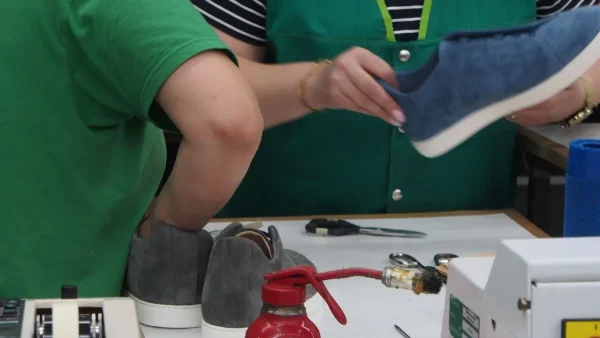
Launching capsule collections
Capsule collections often benefit from a more selective production model. They are usually more focused, more brand-specific and sometimes more experimental. Producing them through a flexible footwear manufacturing approach can help maintain exclusivity while avoiding unnecessary stock pressure.
Entering a new market
When a brand is entering a new region, retail channel or customer segment, small batch shoe production in Europe can help validate assumptions with less risk. Instead of building inventory for a market that has not yet been proven, the brand can use a smaller run to observe demand, pricing tolerance and fit acceptance.
Supporting emerging or independent brands
For newer brands, small batch footwear production may be the only realistic way to move from product idea to first commercial order. It allows development to happen in a more measured way while preserving capital and creating space for product learning.
What brands should consider before choosing smaller runs
Not every brand benefits from smaller production in the same way. Before choosing this route, it is important to assess whether the product and business model actually support it.
First, the brand should be clear about the purpose of the run. Is it for testing demand, supporting selected retailers, validating fit, or building a limited edition? A small batch shoe production strategy works best when the objective is defined early, because that objective affects development priorities, material choices and delivery expectations.
Second, the product itself matters. Some models are easier to produce in lower quantities than others. Complex constructions, heavily customised components, unusual materials or multiple colourways can make a low-volume project harder to manage. In those cases, brands need to simplify strategically, not only creatively.
Third, the commercial plan needs to be realistic. Smaller runs are useful, but they are not automatically efficient if the brand has not thought through channel strategy, replenishment risk, retail timing or target margin. Good planning matters as much in a small order as in a large one.
That is one reason why development support is so important. A manufacturer that can contribute to construction decisions, sampling logic and technical feasibility can help brands avoid costly mistakes early in the process.
How smaller runs affect costs, materials and planning
Brands considering small batch shoe production in Europe should also understand the trade-offs involved. Smaller runs can improve flexibility, but they rarely reduce cost per pair. In most cases, the opposite is true.
Cost per pair
With low MOQ shoe production, development work, tooling effort, setup time and operational coordination are spread across fewer pairs. That usually means a higher unit cost. For brands, the real question should not be whether the cost is lower, but whether the lower commitment and reduced inventory risk justify the higher unit economics.
Material sourcing
Material selection can be more limited in smaller runs, especially when suppliers have their own minimums. Some materials are easier to source flexibly than others. Brands that want smaller quantities often need to prioritise materials that support consistency, availability and repeatability. This is where early sourcing discipline becomes essential.

Planning discipline
Smaller runs do not remove the need for planning. They often require more of it. Development calendars, sample validation, component lead times and production slots still need to be coordinated carefully. In fact, a small order can become inefficient very quickly if the project brief is vague or the product changes too late in the process.
This is why many brands benefit from pairing a small batch strategy with strong footwear development support, clear communication and realistic production expectations.
Why European production can be valuable for low-volume projects
There are practical reasons why small batch shoe production in Europe can be especially relevant for smaller runs. Proximity, communication and development collaboration often matter more when volumes are lower and decisions need to be made more carefully.
For many brands, a European manufacturing partner offers easier coordination during sampling, faster clarification of technical issues and closer alignment between design intent and production reality. This can be particularly valuable in private label footwear projects, where the brand needs not only manufacturing capacity but also reliable technical dialogue.
Smaller runs also benefit from stronger visibility over execution. When the order is limited, each decision matters more. Fit issues, material inconsistency or avoidable delays can have a proportionally bigger impact. Working with a partner that understands product development, construction logic and commercial priorities can therefore make a meaningful difference.
Brands exploring a European partner can learn more through our About Us page, our News section, or related insights such as why a Portuguese shoe manufacturer can be a strategic choice in Europe.
When small batch production may not be the best option
Although small batch footwear manufacturing can be useful, it is not always the right answer. Brands should be cautious about choosing it automatically.
If the product already has strong validated demand, standardised components and a stable commercial plan, a larger production run may be more efficient. In that situation, small batch production can create unnecessary complexity or pricing pressure.
It may also be the wrong choice when the product depends on components with strict supplier minimums, when timelines are unrealistic, or when the brand expects high-volume pricing from a low-volume structure. These are common points of friction and should be clarified early.
In some cases, the better decision is not to produce fewer pairs, but to reduce the number of SKUs, simplify the material matrix, or phase the launch more intelligently. Brands that understand this distinction usually make stronger long-term production decisions.
Conclusion
Small batch shoe production in Europe makes sense when brands need flexibility, lower commitment and better control during early product decisions. It can be especially valuable for pilot launches, new models, capsule collections and more selective commercial strategies. The key is to treat smaller runs as a strategic tool, not as a shortcut.
For brands, the best results come when quantity, development logic, material selection and commercial intent are aligned from the start. A smaller run can reduce risk, but only if the project is planned with clarity and supported by the right manufacturing partner.
If your brand is evaluating a low-volume project and wants to align sampling, sourcing and production more effectively, visit the LG Shoes homepage or contact our team to discuss your next collection.
FAQs
What is small batch shoe production?
Small batch shoe production in Europe usually refers to lower-volume manufacturing runs used to support flexible product development, market testing or focused commercial launches. The exact volume depends on the product, materials and factory setup.
Is small batch footwear manufacturing more expensive?
In most cases, yes. The cost per pair is usually higher because development effort, setup time and operational resources are spread across fewer units. Brands often accept this in exchange for lower inventory exposure and greater flexibility.
When should a brand choose low volume shoe manufacturing?
It usually makes sense when a brand is testing a new design, launching a capsule collection, entering a new market or validating product response before scaling.
Can small batch production help test new footwear collections?
Yes. It can give brands a lower-risk way to test demand, pricing, fit acceptance and channel performance before moving into larger production volumes.
Why do brands choose European manufacturers for smaller runs?
European partners can offer closer communication, stronger development support, easier coordination and better visibility during sampling and early production, which can be especially useful when each production decision carries more weight.


 English

