
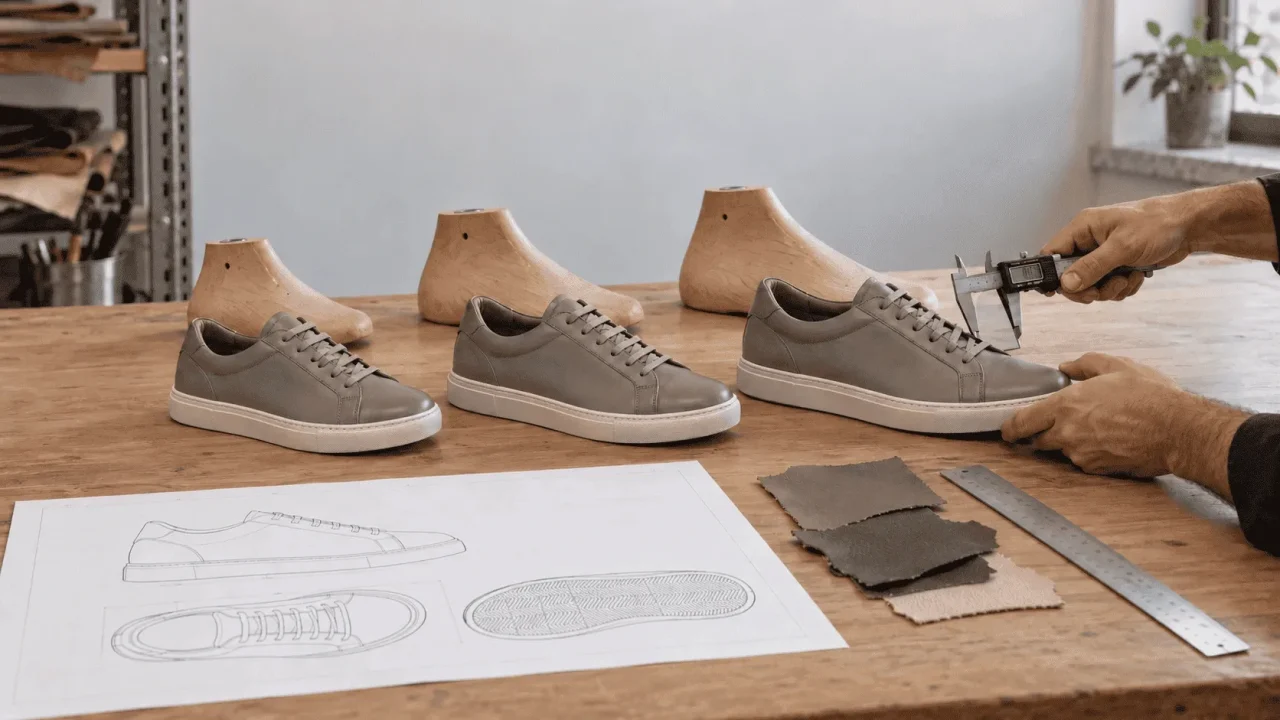
Approving the fit of one sample size is an important milestone in footwear development, but it does not prove that the complete commercial size range will behave in the same way.
Footwear size grading is the controlled process used to develop the dimensions and proportions required as a footwear style moves from an approved base size into smaller and larger sizes.
For brands, this matters because footwear does not simply become uniformly bigger or smaller. The last, upper patterns, outsole, components, internal volume and visual proportions need to remain coordinated as the size changes.
A shoe that works well in the base size can therefore develop fit or proportion problems at the ends of the range if grading is treated as an automatic scaling exercise.
The objective is not to make every size geometrically identical. It is to preserve the intended fit, function and product character across the size range while allowing each graded size to remain technically coherent.
TL;DR
- Approving one base size does not automatically validate the full footwear size range.
- Footwear size grading coordinates lasts, upper patterns, outsoles and components across sizes.
- Length, width, volume and product proportions do not always progress in exactly the same way.
- Pattern grading needs to remain aligned with the graded last.
- Outsoles and other size-dependent components must correspond to the intended size range.
- Materials and construction can change how a graded size feels on foot.
- Representative sizes should be checked where the development risk justifies physical validation.
- Size conversion between EU, UK, US or other systems is not the same as technical footwear grading.
Table of contents
- What is footwear size grading?
- Why does footwear grading start from an approved base size?
- How does last grading influence fit across sizes?
- How does shoe pattern grading work with the last?
- Why do width and volume matter as much as length?
- How do outsoles and components affect the graded size range?
- Can materials and construction change grading results?
- Which sizes should brands validate during development?
- Is footwear size grading the same as size conversion?
- What problems can appear when footwear grading is poorly controlled?
- What should be confirmed before the full size range moves into production?
- People Also Ask
- Final thoughts
- Frequently asked questions
What is footwear size grading?
Footwear size grading is the technical process of developing a footwear style from a defined base size into the smaller and larger sizes required for the commercial range.
This usually involves coordinated changes to the last, upper patterns, bottom components and other size-dependent elements.
The word “grading” can suggest simple proportional scaling, but footwear is more complex than that. A shoe has to accommodate a three-dimensional foot, maintain the intended internal volume and preserve functional relationships between different parts of the product.
The toe, heel, instep, forefoot, topline, fastening system and flex area all need to continue working together as sizes change.
Visual proportions matter as well. An eyestay, quarter panel or heel overlay that looks balanced in the base size should not become disproportionately large or small simply because the pattern has been enlarged mathematically.
For this reason, grading sits between fit engineering, pattern development and production preparation.
Why does footwear grading start from an approved base size?
A reliable grading process needs a stable reference.
The base size is normally the size used to develop and evaluate the initial fit, proportions, upper pattern and relationship between the last and bottom unit.
Before this size becomes the reference for the complete range, the brand and manufacturer should be satisfied that the key fit and construction decisions have been resolved.
If the base size still has excessive heel movement, insufficient forefoot space or incorrect instep pressure, grading that product will reproduce a problem rather than solve it.
The same applies to visual proportions. A collar line, eyestay position or toe shape that is still under development should not become the basis for the complete range too early.
This is why size grading connects directly with the footwear sampling process. Sampling should establish a sufficiently stable product before the development team commits to the wider size range.
A controlled base size provides the technical starting point. Grading then determines how that reference should evolve.
How does last grading influence fit across sizes?
The last defines the three-dimensional internal shape around which the footwear is developed.
It influences length, forefoot width, heel geometry, instep height, toe room and overall internal volume. As a result, last grading is one of the foundations of consistent fit across a range.
A graded last should not be understood as a base last enlarged equally in every direction.
Different dimensions need to progress in a controlled relationship so that each size remains appropriate for the intended wearer and product category.
This is particularly important toward the smaller and larger ends of the range. Small inconsistencies that are difficult to notice around the base size can become more visible when several grading steps accumulate.
The last also has to remain compatible with the intended outsole and upper patterns. If these elements follow different grading logic, the complete shoe may become difficult to manufacture or may fit differently from the approved reference.
The LG Shoes article on footwear fit consistency explains more broadly how last shape, materials, construction and manufacturing tolerances interact with fit.
In size grading, the important point is that the graded last becomes the three-dimensional reference for the other size-dependent elements.
How does shoe pattern grading work with the last?
Once the base upper pattern has been approved, shoe pattern grading develops the pattern pieces required for the remaining sizes.
The pattern must follow the changing last while protecting the design intent of the original style.
This requires control over areas such as:
- vamp length and positioning;
- quarter and heel panel proportions;
- eyestay length and lace spacing;
- collar dimensions;
- seam positions;
- reinforcement areas;
- allowances required for construction and lasting.
Not every visual feature should simply increase at the same proportional rate.
For example, decorative details, branding or certain seam relationships may require controlled positioning so that they remain visually balanced across sizes.
Pattern grading also has a direct functional role. The upper needs to fit the graded last correctly and provide the appropriate material allowance for the selected construction.
If the pattern becomes too large or too small relative to the last, lasting tension, fit, seam position and product appearance can all be affected.
This is why pattern engineering and last development need to remain connected rather than being treated as separate exercises.
Why do width and volume matter as much as length?
Shoe sizing is often discussed mainly in terms of length, but fit is three-dimensional.
Two shoes can have a similar internal length while feeling very different because of width, instep height, toe volume, heel shape or padding.
As a size range is graded, these dimensions need to develop in a way that supports the intended fit profile.
If width progression is insufficient, larger sizes may feel disproportionately narrow. If internal volume increases too aggressively, heel hold or instep security can be reduced.
The product category also matters. A structured leather shoe, soft moccasin and padded sneaker can respond differently even when developed around comparable last dimensions.
For brands, the practical lesson is that size grading should protect the complete fit architecture of the product, not only its nominal length.
This becomes especially important when a brand expects customers to experience a recognizable fit across several models or collections.
How do outsoles and components affect the graded size range?
The upper and last cannot be graded independently from the bottom unit.
An outsole usually needs to correspond to specific last sizes and maintain appropriate relationships at the toe, waist, heel and perimeter of the shoe.
When an existing outsole is selected, brands and manufacturers should confirm which sizes are available and how the supplier’s size set relates to the proposed commercial range.
A custom outsole introduces additional development considerations because the tooling strategy has to account for the required sizes from the beginning.
The LG Shoes guide to footwear outsole selection explains why last compatibility, intended use, weight and construction need to be considered when choosing the bottom unit.
Other components may also be size-dependent.
Depending on the product, this can include:
- insoles and footbeds;
- toe and heel reinforcements;
- zippers or elastic elements;
- laces;
- shanks or structural components;
- certain hardware positions;
- packaging dimensions.
The objective is to make sure that the graded upper is supported by a coherent component system rather than forcing one size solution onto the entire range.
Can materials and construction change grading results?
Yes. A technically correct graded pattern can still produce a different fit experience when materials or construction change.
Leather thickness, stretch, lining structure, foam, reinforcement and internal components influence how closely the upper follows the last and how much usable volume remains inside the shoe.
A soft leather upper may accommodate the foot differently from a heavily reinforced material even when both use the same pattern geometry.
Construction also influences the relationship between the upper and bottom.

For this reason, brands should avoid treating grading as a purely digital or mathematical step that is isolated from the physical sample.
If a significant material or construction change is introduced after the grading logic has been established, its effect on fit and product behavior should be assessed.
This is another reason why the footwear tech pack should remain current. Approved materials, construction and size-related specifications need to reflect the product that is actually being developed.
Which sizes should brands validate during development?
There is no universal rule requiring every size to be physically sampled during development.
The appropriate validation strategy depends on the product, range, grading complexity, target market and level of technical risk.
However, relying only on the base size can leave problems at the edges of the range undiscovered.
For wider size ranges or products where fit is particularly important, brands and development teams may choose to inspect representative sizes in addition to the approved base size.

This can be especially useful for checking:
- visual proportions at the extremes of the range;
- heel and forefoot relationships;
- lace or fastening positioning;
- outsole compatibility;
- upper tension and lasting behavior;
- comfort and internal volume.
The objective is not to generate unnecessary sample rounds. It is to validate areas where accumulated grading changes could create a meaningful risk.
Physical checking should therefore be proportionate to the complexity of the product.
Is footwear size grading the same as size conversion?
No. These are related to sizing, but they solve different problems.
Footwear grading develops the physical dimensions of a specific shoe style across its size range.
Size conversion deals with the relationship between sizing systems used in different markets.
For example, a brand selling internationally may need to communicate European, UK, US or other size designations. The ISO19407:2023 standard provides conversion guidance for major footwear sizing systems based on foot length.
However, converting an EU size label into an equivalent designation does not grade the last, upper pattern or outsole of the shoe.
A conversion chart addresses labeling and size-system relationships. Technical grading determines how the physical product itself changes.
Brands should therefore avoid using consumer-facing conversion logic as a substitute for footwear development specifications.
What problems can appear when footwear grading is poorly controlled?
Grading problems are not always obvious when the base sample is reviewed.
They can emerge only when the complete range is developed.
Typical warning signs can include:
- larger sizes becoming disproportionately narrow or bulky;
- smaller sizes losing the intended toe or heel proportions;
- panel shapes becoming visually distorted;
- lace spacing appearing inconsistent;
- heel hold changing across sizes;
- outsoles no longer aligning correctly with the upper;
- seams moving into undesirable positions;
- internal volume progressing inconsistently;
- branding becoming poorly positioned or disproportionate.
These problems can affect more than appearance.
If the upper no longer corresponds correctly to the last or outsole, manufacturing consistency can also be compromised.
Correcting grading problems late in development may require changes to patterns, components, tooling or samples, with consequences for timing and cost.
A controlled grading review is therefore part of production readiness, not simply a CAD operation.
What should be confirmed before the full size range moves into production?
Before bulk production, brands and manufacturers should ensure that the approved size range is technically aligned.
Relevant checks can include:
- approved base size and fit reference;
- graded last range;
- current graded upper patterns;
- outsole size availability and compatibility;
- size-dependent components;
- commercial size range;
- materials and construction specification;
- representative size validation where required;
- branding and detail positioning across sizes;
- current technical documentation and version control.
Any exceptions should be documented rather than left as assumptions.
If, for example, one outsole mold covers more than one nominal size or a particular component changes at a defined size, the development and production teams need to know exactly where that transition occurs.
The same principle applies to different size systems or market-specific ranges.
The final objective is a production specification in which the last, patterns, bottom unit and components all describe the same approved size architecture.
People Also Ask
What does grading mean in footwear?
Grading is the process of developing a footwear style from an approved base size into the smaller and larger sizes required for the commercial range. It can involve lasts, upper patterns, outsoles and other size-dependent components.
Why is shoe size grading important?
Shoe size grading helps maintain fit, proportions and manufacturing compatibility across a size range. Without controlled grading, a shoe that fits correctly in the base size may behave differently in smaller or larger sizes.
Is the shoe last graded before the upper pattern?
The last provides the three-dimensional fit reference for the shoe, so the graded pattern needs to remain aligned with the corresponding graded last. Exact workflows can vary between development systems and suppliers.
Does every footwear size need a physical sample?
Not necessarily. The appropriate validation strategy depends on the product and development risk. Representative sizes may be checked when the size range, construction or fit requirements justify additional physical validation.
Final thoughts
Footwear size grading is where an approved fit begins to become a commercial size range.
The process connects last development, pattern engineering, outsoles, components, materials and construction. If one of those elements follows a different grading logic, consistency can be lost even when the base sample was correct.
For brands, the most important principle is not to assume that one approved size automatically validates every other size.
A reliable grading process starts with a stable base product, maintains controlled relationships as dimensions change and uses targeted validation where the technical risk justifies it.
That approach helps protect both fit consistency and the visual identity of the product before the complete range moves into manufacturing.
At LG Shoes, footwear development combines technical collaboration, sampling, fit evaluation and manufacturing expertise in Portugal. Brands developing a new footwear collection can contact LG Shoes to discuss their development and production requirements.
Frequently asked questions
Can the same grading rules be used for every type of footwear?
Not necessarily. Product category, last geometry, construction, materials, target fit and size range can influence how a style should be developed across sizes. Grading should reflect the requirements of the actual product.
What is a base size in footwear development?
The base size is the reference size used to develop and evaluate the initial last, upper pattern, proportions and fit. Once sufficiently approved, it provides the starting point for grading the wider size range.
Can a footwear size range use more than one outsole size strategy?
Yes. Bottom-unit sizing depends on the outsole system and supplier or tooling strategy. The relationship between nominal shoe sizes and available outsole sizes should be defined clearly during development.
Does pattern grading automatically protect footwear fit?
No. Pattern grading is only one part of fit consistency. The graded pattern must remain compatible with the last, materials, construction, outsole and internal components.
Should branding placement change between footwear sizes?
It may require controlled adjustment depending on the design. The objective is to maintain visually balanced positioning rather than allowing a logo or decorative element to become disproportionate as the shoe changes size.
When should footwear size grading be finalized?
The grading should be sufficiently resolved before bulk production, once the base fit, last, pattern, bottom unit, materials and relevant size-dependent specifications have been approved and aligned.


 English

